Building SEO-Friendly Web Pages: Research and On-Page Essentials

Your growth engine runs while you run your business
SEO, Google Business, blog content, and email, one dashboard, Bay Area founders only.
Summary
This post is Module 2 of 15 in my ongoing SEO 101 series, marking Part 2 of 5 focused on core website structure. Data demonstrates that page relevance, mobile optimization, and loading speed directly dictate whether search engines index and rank local business pages. Building an SEO-friendly page requires aligning your page titles, main headings, and body copy so search engines and human visitors immediately understand your primary service.

What the research says
Data compiled by instantpress.co shows that organic search drives 53% of all trackable website traffic across the web. This makes search engines the single largest origin point for business web visits.
Research from instantpress.co also reveals that the first organic search result on Google receives an average click-through rate of 27.6%. Securing top placement captures more than a quarter of all search clicks for a given query.
According to blazehive.io, text relevance exhibits the highest statistical correlation with a page's Google ranking position at 0.47. Search algorithms prioritize pages where on-page written text directly mirrors user search intent.
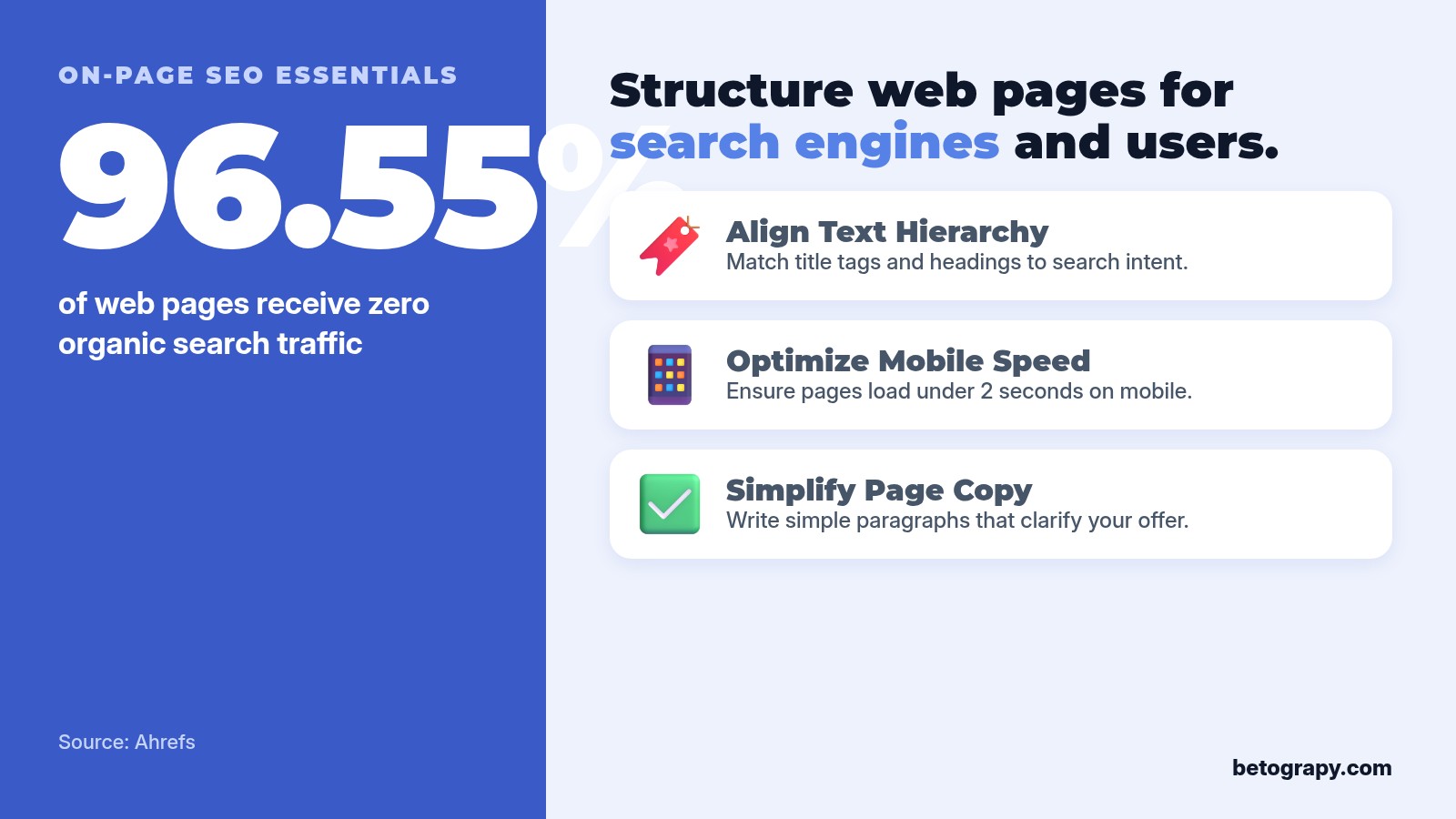
A study by Ahrefs indicates that 96.55% of all published web pages receive zero organic search traffic from Google. Most online content remains completely invisible to prospective customers after publication.
Findings published by GrowthSRC report that organic search click-through rates across positions 1 through 5 declined by 17.92% from 2024 to 2025 following the rollout of AI Overviews. Securing strong top-page real estate is necessary to retain traffic as search page layouts change.
Data from SEOvoyage establishes that mobile web traffic accounts for 63% of all global organic search traffic. Mobile responsiveness is fundamental for any published commercial page.
Performance benchmarks from clickrank.ai confirm that web pages that take longer than 3 seconds to load experience a 32% higher bounce rate compared to pages that load under 2 seconds. Slow load speeds push visitors off your site before they read your offer.
Additional research from Ahrefs shows that only 1.74% of newly published web pages manage to reach the top 10 Google search results within one year. Reaching front-page positions requires deliberate page target accuracy and technical clarity.
What it means in practice
When I ran my own small businesses through changing market shifts, I learned that clear structure beats complicated layouts every time. In my opinion, making a web page SEO-friendly boils down to explaining your service clearly to both a human reader and a web crawler without confusing either one.
Google reads a web page from top to bottom, checking specific structural markers. Your title tag tells Google the primary topic of the page, while your main heading tag acts as the visible headline. When these elements match your body text and clearly describe your offer, search engines can evaluate and categorize your content correctly.
Many business owners publish pages that look polished visually but lack clear text hierarchy underneath. Implementing proper technical SEO services ensures your page code, heading tags, and asset load times meet search engine standards. If search engine crawlers cannot process your page layout easily, your content gets left behind regardless of your service quality.
You do not need deep programming knowledge to start improving your site performance. Auditing your site with a free SEO analyzer quickly surface missing heading tags or alignment issues. Evaluating local marketing partners alongside transparent agency pricing gives local business owners full clarity on which structural updates deliver actual search growth.
Limits of this evidence
These broad industry figures reflect global web traffic patterns across millions of diverse websites. They do not guarantee identical ranking timelines for local niche trades or localized commercial services.
A local service page faces different competitive pressures than a national online store. Technical page optimization forms a baseline, but it cannot overcome poor business operations or a complete lack of local service demand.
What to do with this
First, inspect the main heading and page title on your core service page to confirm your main service name appears clearly. Second, rewrite long text blocks into simple, clear paragraphs that directly address customer needs without extra fluff. Third, open your website on a mobile phone to confirm your pages load rapidly and display clearly on smaller screens.
Part 3 of this 5-part web page optimization guide will be released in the next entry of our 15-part SEO 101 series.
More on this: how a Bay Area SEO agency approaches it. Or see a real local SEO result, with dates.
 Halfway there! The free check finds your own fixes in a minute.
Questions about this?
Text Beto at (510) 833-8838, or send your question here. You get the answer by email, usually the same day.