How to Pick a Marketing Agency That Sells

This article is Module 2 of 15 in my ongoing SEO 101 series, and Part 1 of 5 covering search fundamentals. When business owners ask how to pick a partner, my position is uncompromising: the right choice is always the agency that targets exact customer search behavior rather than clever advertising copy. A keyword is simply the exact string of words a customer types into Google when they need an answer immediately.
When I ran my own small businesses through COVID, I learned that stylish copy does not pay bills if customers never find your website. Many marketing agencies rely heavily on flashy design work while completely ignoring how real people search. If a homeowner has an overflowing toilet at midnight, they never search for holistic residential plumbing care. They type late night plumber open now into their phone.
Guessing what people type is where most marketing plans fail completely. Business owners often write website copy using internal industry jargon that no customer ever uses. True search optimization begins by discovering the real phrase a neighbor types into a search box during a moment of need.
Your growth engine runs while you run your business
SEO, Google Business, blog content, and email, one dashboard, Bay Area founders only.
Why Keyword Reality Beats Pretty Copy Writing
Understanding real search intent requires looking at plain human habits rather than creative awards. When buyers go online, they want fast answers to concrete problems. Research shows search queries containing three or more words convert 6.1 times better than one and two word queries, according to milan-novotny.com. That proves that specific, plain language phrases drive real business growth far better than broad brand statements.
In fact, informational search intent accounts for 60 percent of the most popular search keywords analyzed, according to marketingprofs.com. People are looking for direct answers to very specific questions before they make a buying decision. An agency that focuses only on sounding clever misses the chance to answer those exact questions when buyers are actively looking.
Evaluating an agency requires asking them to explain their exact process for finding these intent driven phrases. Superior agencies build specific web pages around genuine user queries, whereas average agencies publish generic blog posts that rank for nothing. Reviewing an agency’s documented case study results will show whether they understand target phrases or merely produce filler text.
Google processes millions of brand new queries every single day that have never appeared before. Roughly 15 percent of all daily Google searches are entirely new terms, as reported by webtonic.io. An agency that relies on old marketing formulas instead of live search data will continuously miss how your actual customers seek help.

The Argument for Brand Storytelling First
The strongest argument against prioritizing raw search terms is that an intense focus on keywords can weaken a brand’s unique identity. Creative directors often contend that emotional storytelling builds long term customer loyalty better than search rankings. They argue that optimizing for search algorithms turns website copy into repetitive, robotic text that turns away discerning human readers.
That argument is valid when an agency handles search optimization poorly. Unskilled writers cram target terms into every paragraph until the content feels artificial and hard to read. That outdated tactic damages user trust and fails to turn website visitors into paying clients.
However, real search optimization never forces a choice between clear writing and target keyword integration. Expert teams integrate precise phrases naturally into engaging copy that speaks directly to human needs. Addressing structural site issues through sound technical SEO allows search engines to find your site while keeping your brand voice human and direct.

How to Evaluate Agency Keyword Expertise Today
When selecting a marketing partner, insist on full clarity regarding how they discover target phrases and track progress. Ask prospective agencies to explain how they filter out useless vanity search terms in favor of actual commercial queries. A reliable partner will openly explain their price structure and show exactly how query research connects to client revenue.
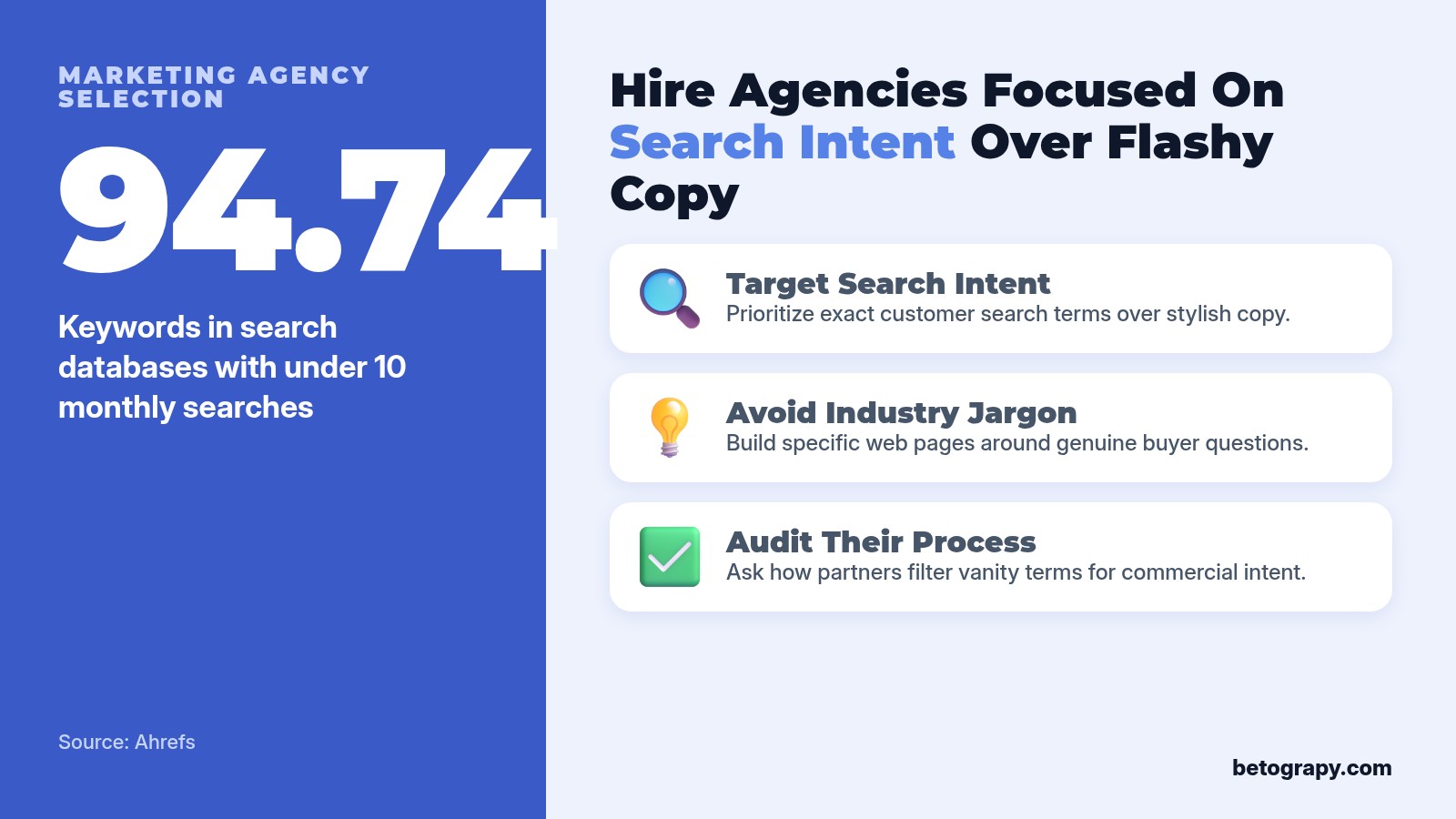
Pay close attention to whether the agency understands the value of specific low volume queries. Data shows that keywords with fewer than 10 monthly searches make up 94.74 percent of all keywords in search databases, according to Ahrefs. Agencies that ignore these specific phrases throw away the most qualified sales opportunities available to local companies.
Selecting the right search marketing team comes down to choosing experts who respect the exact words your buyers use every day. Keyword optimization is not about tricking search engine algorithms with clever tricks or fancy language. The best agency for your business will always be the one that grounds every page in real customer search intent rather than poetic agency prose.
Look for Part 2 of this search series next week, where we will dive into analyzing search intent to turn raw queries into direct service calls.
More on this: what a Bay Area SEO company actually does. Or see a real local SEO result, with dates.
 Halfway there! The free check finds your own fixes in a minute.
Questions about this?
Text Beto at (510) 833-8838, or send your question here. You get the answer by email, usually the same day.