Local SEO for Bay Area Small Business: 5 Easy Fixes
Improve website traffic for your Bay Area small business by fixing five common local SEO mistakes. Learn to optimize your Google profile and get found.

You know the exact feeling of a slow Tuesday afternoon. The phone sits silent on the desk. The shop floor is quiet. You pull out your phone to search for your own services just to see what happens. A competitor you know does inferior work shows up first on the map. You remember the money you spent on generic ad campaigns last year. Those ads brought nothing but empty clicks. That frustration is real.
This guide is for local business owners in Walnut Creek, Fremont, and the surrounding communities. You are tired of being invisible online. You will get the exact steps to fix your digital foundation. You can capture the customers who are actively looking for you right now.
Your growth engine runs while you run your business
SEO, Google Business, blog content, and email, one dashboard, Bay Area founders only.
Why is my Google Business Profile so important?
Your Google Business Profile is the absolute most critical digital asset for any local business. It is usually the very first piece of information a customer sees when searching for services nearby. Leaving your profile incomplete is like opening a physical shop in town without hanging a sign above the door. A blank profile drives customers away. Many local business owners claim their listing on Google Maps but fail to fill out every section.
When key sections of your profile are missing, you miss direct opportunities to connect. People are actively looking for your exact services in their neighborhood right now. Missing business categories, blank service descriptions, and unlisted business hours cause major problems. They make it hard for search algorithms to recommend your listing over a competitor. Another frequent oversight is ignoring customer reviews on your profile. Relying solely on good service to generate reviews without asking for them directly is a costly mistake. Reviews signal trust, quality, and authority to both search engines and prospective buyers.
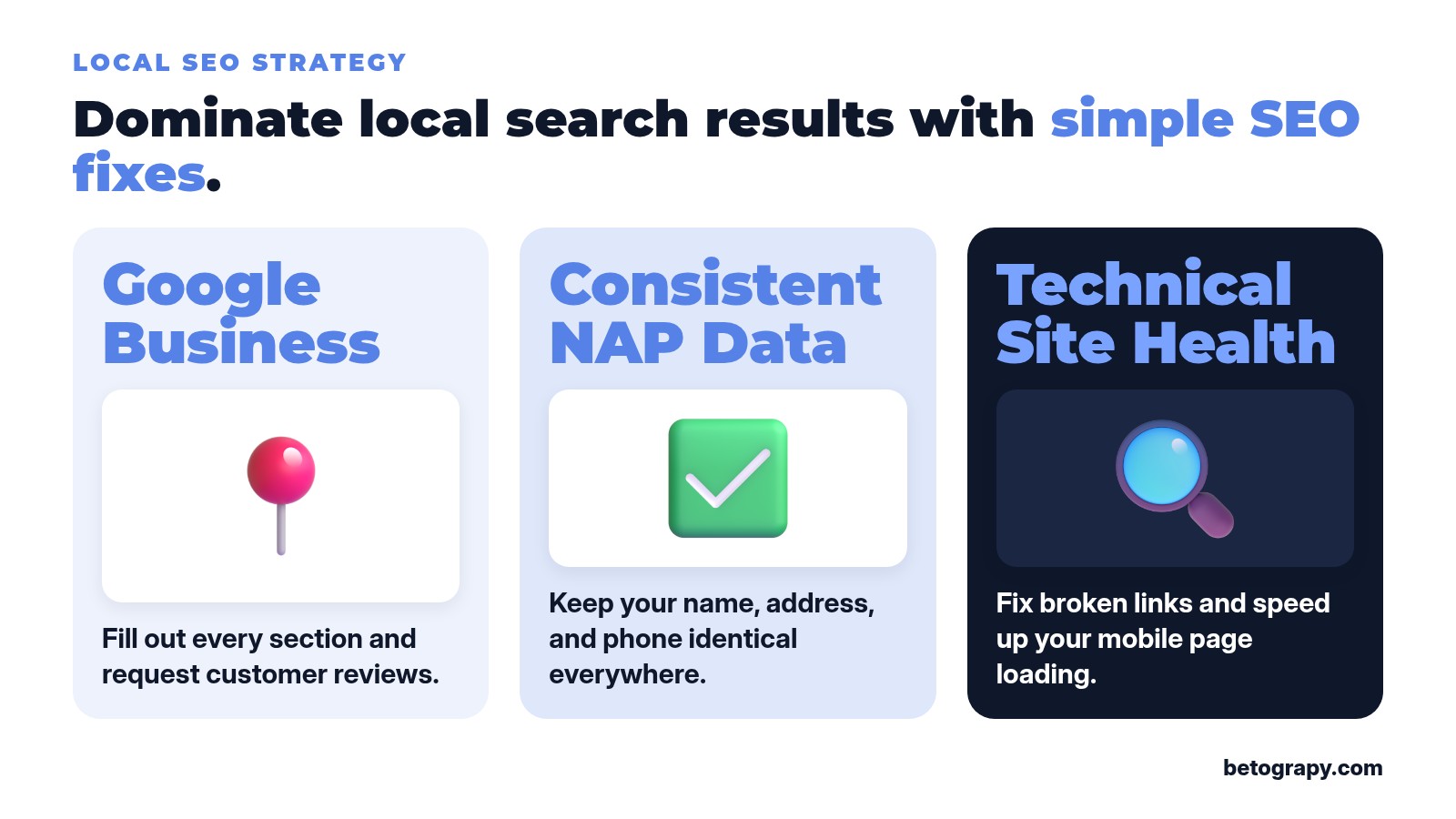
Log into your Google Business Profile and complete every single field available today. Select your primary and secondary business categories carefully based on your core offerings. A bakery might choose “Bakery” as primary and “Coffee Shop” as secondary. Write a clear business description and list your exact operating hours. Upload high quality photos of your work, your team, and your physical location. Think about the curb appeal of your physical location, because your photos are its digital equivalent. Establish a regular process to request reviews from satisfied customers. Always respond promptly and professionally to every review, whether positive or negative.
A fully completed profile provides structured data about what you do and where you operate. Search algorithms use that data to match your listing with relevant local searches with high confidence. Fresh reviews and active responses show search engines and buyers that your business is legitimate, responsive, and open for business. Adding features like direct scheduling right there on your profile removes friction from the buying process. People can book appointments or reserve tables directly from your profile. They often do this without even needing to visit your website.
You must check your profile regularly to ensure no unauthorized changes appear. Sometimes automated systems or users suggest edits to your business hours or location. Catching these errors early prevents lost customers. Small details make the biggest difference.
How do you improve website traffic in the Bay Area?
You improve website traffic by fixing the underlying technical errors that prevent search bots from indexing your critical landing pages. A business website stuck on page two or three of search results is functionally invisible to high-intent buyers. Dropping from position three to position twelve can significantly reduce inbound inquiries. This revenue drop often happens gradually, making it difficult to spot until month-end financial reviews reveal a shrinking pipeline.
If search engines encounter slow server response times, duplicate title tags, broken internal links, or poor crawl paths, they stop indexing your site. Search bots give up easily. Many business owners attempt to compensate for silent ranking drops by pouring extra capital into expensive pay-per-click advertising campaigns. Paid ads deliver temporary traffic spikes, but your cost per acquisition skyrockets while your underlying digital assets continue to deteriorate underneath. Relying solely on paid ads creates a dangerous dependency that erodes profit margins over time.
Start by pulling a complete crawl audit of your domain to spot broken URLs, missing meta descriptions, duplicate title tags, and slow-loading pages. Compress oversized image files, defer non-essential JavaScript, and eliminate render-blocking scripts to improve mobile performance metrics. Repair broken internal links and build a clean, logical site structure. Establish clear internal link paths from your high-authority homepage directly to core solutions. Refresh older service pages with accurate details, clear answers, and targeted solutions. Update headers, add fresh project examples, and align page content with modern search intent.
Fixing site health generates compounding organic traffic that permanently lowers your long-term customer acquisition costs. A well-optimized technical foundation ensures that every new page, case study, or service update you publish immediately indexes and gains search visibility. Structuring a high-performing website demands clean code standards and precise crawling instructions for search engine spiders. When you eliminate hidden roadblocks, search engines can easily read and recommend your site to local searchers.
Ignoring technical errors guarantees that your competitors will capture your target audience. You cannot win searches if your pages fail to load quickly. Fast sites always win.
How do website local signals and address consistency work?
Your website serves as your primary digital storefront, and it must clearly communicate your geographic relevance to search engines. A common oversight is focusing purely on general service keywords while ignoring local geographic terms. If your website does not mention your city, neighborhood names, or service areas, search algorithms will struggle to link your site to local search intent. Including terms such as San Francisco digital marketing or Walnut Creek digital marketing helps search engines connect your services to nearby buyers.
Another frequent problem is an inconsistent online presence across the web. Mismatched business information confuses search engines and prospective clients alike. If your business Name, Address, and Phone number, often referred to as NAP, vary between your website, social profiles, online directories, and map listings, search engines lose confidence in your data. Even a slight variation between “St.” and “Street” can dilute your local authority.
Conduct a thorough audit of your business NAP information across all directory sites, review platforms, social accounts, and your website footer. Ensure every detail matches word for word. List your business on prominent directories like Yelp, Yellow Pages, and industry-specific platforms relevant to your niche. Update your website copy to include clear references to your city, neighborhood, and surrounding service areas. Naturally weave local keywords into your page titles, meta descriptions, and headings. Instead of just “dentist,” use “Fremont Family Dentist” or “Dental Implants Mission San Jose.”
Consistent NAP data across multiple authoritative sources confirms your physical location to search algorithms. Placing specific geographic keywords in your website content makes it easy for search engines to surface your pages when local prospective buyers search for services in your area. Implementing local business schema markup also helps search engines understand specific information about your business, such as your address, phone number, hours, and services.
Search engines crave certainty before they recommend your business to a local user. Consistent address formatting provides that exact certainty. Your local rankings depend on it.

Why build dedicated service area pages?
A major reason businesses fail to capture local search traffic is that they lump all their services and locations onto a single webpage. If your business serves multiple cities like Walnut Creek, Concord, and Lafayette, a single homepage cannot effectively rank for all those local searches. Search engines prefer to send users to a highly specific page that matches their exact geographic search.
Creating dedicated service area pages is a straightforward way to capture more local search intent. Instead of just listing the cities you serve in your website footer, build an individual page for each specific location. This allows you to speak directly to the customers in that neighborhood and provides search engines with clear local signals. A family new to Centerville looking for a birthday cake needs to find a page that speaks directly to their location.
Focus on one city per page. Write unique content for each location rather than copying and pasting the exact same text with a different city name. Highlight local projects by including photos and descriptions of work you have completed specifically in that community. Embed a Google Map showing your service radius or driving directions from that specific neighborhood to your physical office. Feature testimonials from clients who live in that exact city to prove you are an active local provider.
By dedicating a specific page to each community you serve, you make it incredibly easy for search engines to understand your service area. This targeted approach directly helps match your pages with the exact local search terms your prospective buyers are using. When a pipe bursts in the middle of the night, a plumbing service in Niles with a dedicated location page becomes the go-to choice for a nearby search.
Local customers want to hire people who understand their specific neighborhoods. A dedicated page proves you work there. Build one for every city.
How do you build local community content and links?
Many local business owners fall into the trap of thinking all website links are the same, or that link building is unnecessary for local search. Acquiring generic or low quality links from unrelated websites provides very little value for local rankings. High quality backlinks from respected local businesses, community organizations, civic groups, and local news websites carry far more weight in local search algorithms.
Failing to participate in local community content weakens your online presence. Your business exists inside a physical community, and your digital footprint should reflect that reality. Ignoring local events, community sponsorships, and local business partnerships isolates your business from the local digital ecosystem. Earning genuine PR coverage requires sharing original local market data, real human interest stories, or authentic community initiatives that journalists actually care about reporting.
Build real relationships within your local community. Sponsor local events, collaborate with complementary local businesses, and participate in community news or local organization activities. Secure links back to your website from local business directories, community event pages, local chambers of commerce, and regional news stories. Offer to write a guest post for a local blog or online publication, linking back to your site. Use tools like SEMrush and Ahrefs to conduct a thorough competitor backlink analysis and identify what keywords your top local competitors are ranking for that you lack.
Backlinks from local organizations serve as powerful votes of confidence for search engines. When authoritative local websites link to your domain, search algorithms recognize your business as an established and trusted member of the local community. Understanding your competitors allows you to build content strategies around those gaps and capture high-intent local search terms.
Links from local websites act like digital word of mouth referrals. You need these votes to win search visibility. Community involvement builds real links.
Why must you align social media profiles with local search?
Treating social media and local search as unrelated tasks is a widespread mistake. Think of your total online presence like a physical storefront on a busy neighborhood street. Local search brings interested shoppers directly to your front window when they are looking for a specific service. Your social media channels show those shoppers what is taking place inside your business right now.
Modern consumers rarely rely on a search result alone. A prospective client might find your business listing on Google Maps while searching on their phone during lunch in downtown Walnut Creek, CA 94596. If your map profile looks promising, they will frequently hop over to social platforms like Instagram, Facebook, or LinkedIn to verify that your business is active, professional, and engaged with customers. When your social pages echo the same accurate business details and active energy as your search profile, you build immediate confidence during critical buying periods like Q4.
Ensure your social media profiles display the exact same business name, address, phone number, and website link as your Google profile. Keep your social channels updated with recent project photos, customer highlights, and current updates that show your team at work in the local community. Identify the specific platforms where your target audience spends their time most actively, and focus your efforts there rather than trying to be everywhere at once.
Matching your search listings with active social channels creates a validation process for prospective clients. Active social profiles send strong trust signals across the web, proving that your business is open, busy, and ready to serve local customers. Authentic interaction on social media transforms followers into a community, creating a more personal and impactful connection than simply pushing products.
Social proof closes the sale after search brings the lead. People want to see your recent work. Post photos every single week.
How do generative AI and seasonal content help?
Creating regular marketing content is one of the biggest challenges for busy local business owners. Many owners struggle to find the time to write blog posts or social updates consistently. Data shows that 58 percent of small businesses now use generative AI tools to assist with content creation. Underestimating or ignoring these tools means missing out on valuable efficiency gains.
Another frequent oversight is ignoring seasonal search intent and promotional timing. During key periods such as Q4, local search demand increases as buyers look for seasonal services, holiday offers, and end of year solutions. Failing to publish timely, geo-targeted content or seasonal promotions leaves valuable search traffic and customer inquiries to competitors. You need a system designed for speed and clarity, not endless waiting.
Incorporate generative AI tools into your regular marketing workflow to draft blog posts, brainstorm ideas, and refine promotional copy. Combine AI efficiency with your personal industry experience and local knowledge. Plan and publish seasonal promotions and local updates to capture increased demand during peak search periods. Set up automation that will publish weekly blog content and consistent updates to your Google Business Profile.
Generative AI streamlines the content creation process, allowing you to maintain a consistent online output without taking focus away from daily operations. Publishing seasonal, geo-targeted content aligns your business with active search trends when customer buying intent is at its highest. Automating repetitive marketing activities frees up your valuable time, allowing you to focus on running your business.
AI gives you back the hours you need to manage your shop. You no longer have to stare at a blank screen. Write faster today.
What can we learn from major media outlets about publishing?
Major publishing outlets like the New York Times dominate search engine results because they operate with strict digital discipline. They do not rely on luck or sporadic bursts of effort. Instead, they publish structured, helpful content on a set schedule. Local service providers can apply these exact publisher strategies without needing a massive media budget.
Continuous publishing outlasts one-time hits. A common mistake among local companies is publishing five blog posts in a single week and then remaining silent for six months. Search engine algorithms reward steady, regular updates over erratic bursts. Major media outlets also group articles into tight categories and subtopics. When setting up local digital marketing structures, every website should be built around core service categories and dedicated location pages.
Build a simple weekly publishing schedule. Organize your content into clear service and location clusters. Monitor baseline lead metrics regularly to decide which subtopics deserve deeper coverage. If you do not track your baseline numbers, you cannot identify which published pages generate actual phone calls and which ones need improvement. Feature yourself, your team, and your real job sites in your weekly updates.
Search engines favor sites with structured architecture and steady updates. Tracking baseline data keeps your effort focused on actions that drive leads. Organizing your site into clear topic clusters helps search engines index pages faster and understand exactly where and how you operate. Demonstrating real work in local neighborhoods builds trust far faster than generic corporate branding.
Consistency builds your search authority over months of steady work. Small updates every week beat a massive update once a year. Stay strictly on schedule.
How did I learn these local marketing lessons?
I know how challenging it is to build and maintain a business because I have walked in your shoes. I came to the United States from Mongolia, worked three jobs at once to get on my feet, and eventually opened a dry cleaning business with my family. We put our hearts into serving our local community every single day. When COVID hit, foot traffic came to a sudden halt, and we were forced to close our doors. That hard experience taught me firsthand that having a great service is not enough if local customers cannot find you online when they need you.
Today, I do this marketing work myself for small business owners in Walnut Creek and across the Bay Area while pursuing a higher degree. Every day, I work directly with local founders, contractors, and store owners. I see talented people losing potential clients simply because their Google listing is incomplete, their business address is inconsistent across directory sites, or their website lacks local signals.
Resolving these foundational local SEO errors is not about complex agency jargon or temporary tricks. It is about building a clean, honest online presence that protects and reflects the hard work you do every day. Your physical business needs a digital reflection that matches its quality. Fixing these basic errors gives your business a fighting chance.
I watch owners miss phone calls just because their phone number is wrong on Yelp. I see contractors lose bids because their service area page is missing. My daily work revolves around fixing these exact problems for local founders.
You cannot afford to lose customers to technical errors. I learned this through painful personal experience. Fix your digital foundation today.
Is doing your own marketing a good idea?
I got this wrong at first. It happens to many of us. The “do it yourself” approach to digital marketing seems like the most cost-effective option on the surface. You save on agency fees, you maintain complete creative control, and you gain a deeper understanding of various platforms.
The learning curve for effective digital marketing is steep, constantly changing, and demands consistent attention. You might spend hours crafting social media posts, only to see minimal engagement, or dedicate weekends to optimizing your website without understanding the deeper analytical insights needed to truly improve search rankings. Every hour you spend trying to master Google Ads is an hour not spent serving clients, developing new products, or refining your service.
It is an opportunity cost that often outweighs the initial financial savings. The expectation that every owner can or should become a digital marketing wizard overnight is unrealistic and often counterproductive. You have a business to run, inventory to manage, and customers to help in your shop.
Trying to manage duplicate title tags and broken internal links takes specialized knowledge. Your time is too valuable to spend studying search algorithms. Focus on your actual business.
What can search optimization actually fix?
While local search optimization is essential for attracting nearby buyers, you must be completely clear about what it cannot accomplish. Local SEO will not fix a flawed core service, poor customer service, or pricing that is disconnected from your local market. Search optimization works to bring prospective clients to your digital door, but your operational quality and customer service determine whether those leads turn into long term customers.
Building profile authority, gathering authentic customer reviews, and earning local links require ongoing attention. Results build gradually over weeks and months of consistent work rather than overnight spikes. Search visibility gets people to call your phone, but you still have to answer it politely and do good work.
If your bakery in Walnut Creek makes terrible coffee, search traffic cannot save you. If your dental practice in Fremont treats patients poorly, online visibility only accelerates your bad reputation. A clean online profile amplifies the reality of your actual business operations.
You must deliver an excellent physical service before marketing matters. Good SEO highlights a good business. It cannot hide a bad one.

Frequently asked questions
Why is my Google Business Profile so important for my local business?
Your Google Business Profile is often the very first interaction a potential customer has with your business online. An incomplete profile prevents search engines from properly understanding your location and services, causing your business to get lost in local search results. Completing every field ensures search engines can display your business accurately to nearby searchers.
How do Google reviews help my local business show up in searches?
Positive Google reviews provide crucial proof of quality and trust for both search algorithms and potential buyers. Actively gathering and responding to reviews signals to Google that your business is active and reliable, which helps your profile rank more prominently. Sharing these reviews on your website and social pages reinforces customer trust across all channels.
How do social media activity and local search work together for my business?
Local search listings capture prospective clients who are actively looking for immediate services, while active social profiles allow those clients to verify your current work and team culture. When your social channels maintain consistent business details and regular posts, they reinforce your search listings and turn curious searchers into confident customers.
What technical errors cause Google to stop indexing a website?
Search engine bots stop indexing critical landing pages when they run into slow server response times, duplicate title tags, or broken internal links. Poor crawl paths also make it difficult for bots to navigate and evaluate your site. Fixing these structural issues ensures your pages remain visible in search results.
Improving your local search presence in the Bay Area does not require tackling every task at once. Select one or two areas from this guide, such as completing your Google Business Profile or standardizing your business address across online directories, and execute them this month. Small, consistent steps compound quickly, and a few months of steady work will always produce better results than a single rush that fizzles out. Finding the right Bay Area SEO company can help you fix these technical steps if you prefer not to handle them alone. If you want to know exactly where your own business stands right now, you can run a free SEO and Google Business Profile check to see the one thing costing you customers.
 Halfway there! The free check finds your own fixes in a minute.